
SEO for law firms is essential for attorneys and legal practices. It helps to improve online visibility, attract qualified clients, and compete in today’s digital landscape. Most people searching for legal services start with Google. Law firms that appear higher in search results often generate more traffic, consultations, and long-term business.
Unlike paid advertising, legal SEO aims to increase organic rankings. It does this through keyword optimization, local SEO, content marketing, technical improvements, and authority building. A strong SEO strategy can help law firms rank for valuable searches in their practice areas and build trust with potential clients.
In this beginner’s guide, you’ll learn how law firm SEO works, why it matters, and the most effective strategies lawyers can use to improve rankings, increase local visibility, and generate more leads through organic search.
What Is SEO for Law Firms?
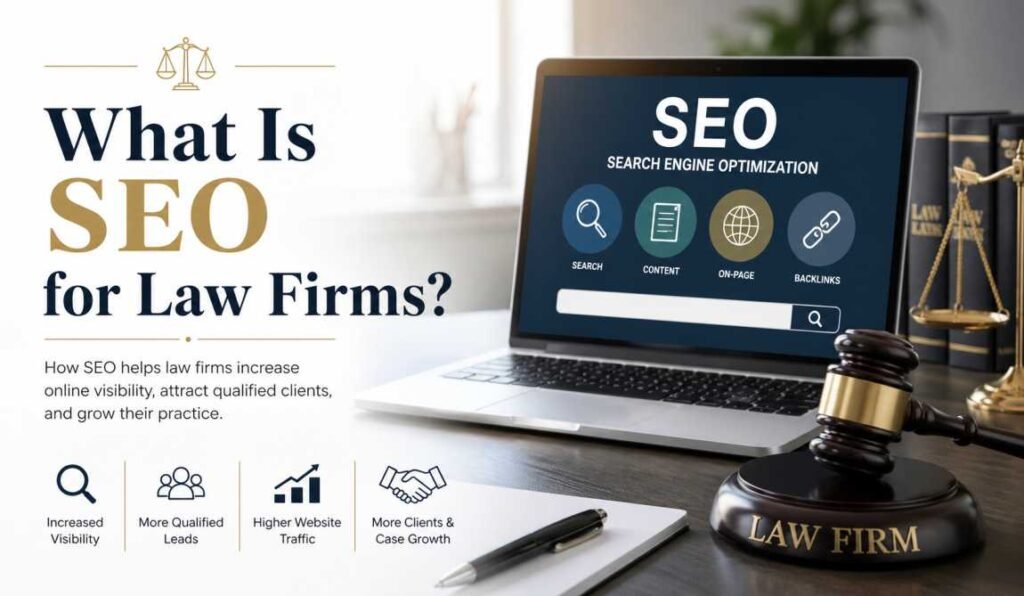
SEO for law firms means making a law firm’s website show up better in search engines. The goal is to help people find your firm when they search online for things like divorce lawyers, criminal defense, or business legal help.
Law firm SEO involves multiple strategies, including keyword research, local SEO, content optimization, technical SEO, and link building. These strategies work together to improve search rankings, increase organic traffic, and generate qualified leads for legal practices.
How Law Firm SEO Works
Search engines like Google analyze websites using specific rules. They check if your site matches the search, has good content, links from trusted sites, is easy to use, and is honest. When people look for legal help, Google tries to show the best and most trustworthy sites first.
For example, if a user searches for “personal injury lawyer near me,” Google evaluates law firm websites based on:
- Local relevance
- Website authority
- Content quality
- Online reviews
- Backlinks
- Mobile experience
- Search intent optimization
Law firms with stronger SEO signals are more likely to rank higher in search results.
Difference Between SEO and Paid Advertising
SEO and paid advertising both help law firms generate leads, but they work in different ways. Paid ads can place your website at the top of search results immediately, but traffic stops once your advertising budget ends.
SEO is focused on building long-term, unpaid visibility in search engines. It typically takes time to achieve higher rankings, but once established, SEO brings consistent traffic and leads without ongoing payments. Paid ads, in comparison, only generate immediate visits as long as the ad campaign is funded.
Many successful law firms combine SEO with paid advertising, but long-term organic rankings often provide better sustainability and credibility.
Why Legal SEO Is Highly Competitive
The legal industry is very competitive in digital marketing. Legal keywords often have high commercial value. Multiple law firms compete for the same terms, especially in big cities and popular practice areas.
This is why law firm SEO requires more than basic optimization. To compete effectively, legal websites need:
- High-quality content
- Strong local SEO
- Authoritative backlinks
- Excellent user experience
- Consistent online authority signals
Why SEO Matters for Law Firms
A professional website alone is not enough in the modern legal industry. Law firms also need strong online visibility to compete for clients. This is where SEO is essential. Most people searching for legal services use search engines to find attorneys, compare firms, read reviews, and schedule consultations.
Increase Online Visibility
SEO helps law firms appear in search results when potential clients search for legal services in specific practice areas. Higher rankings increase visibility and make it easier for users to discover your firm before competitors.
For example, ranking for searches such as:
- “personal injury lawyer”
- “family attorney near me”
- “criminal defense lawyer”
can drive highly targeted traffic from people actively searching for legal help.
Generate More Qualified Leads
A big benefit of law firm SEO is getting visitors who already want legal help. Unlike old ways of advertising, SEO helps you reach people who are already searching for lawyers online.
When your website ranks for relevant keywords, traffic is more likely to convert into consultation requests, phone calls, case inquiries, and potential clients.
- phone calls
- case inquiries
- potential clients
This is why SEO is one of the best ways for lawyers to generate high-quality leads over the long term.
Build Trust and Credibility
Users often trust websites that appear on the first page of Google more than those that rank lower. Strong rankings can improve a law firm’s credibility and authority in the eyes of potential clients.
SEO also helps build trust through:
- high-quality legal content
- positive reviews
- authoritative backlinks
- secure and user-friendly websites
- strong local presence
These trust signals are especially important in the legal industry, where clients seek reliable, experienced legal representation.
Long-Term ROI Compared to PPC
Paid advertising can bring quick traffic, but is often expensive in legal markets. SEO focuses on building organic visibility over time.
Although legal SEO requires ongoing effort, it can deliver long-term benefits such as consistent organic traffic, lower customer acquisition costs, stronger brand authority, and long-term lead generation.
- lower customer acquisition costs
- stronger brand authority
- long-term lead generation
Why Law Firms Need a Legal-Specific SEO Strategy
SEO strategies can vary significantly across industries, and what works for an e-commerce store or a local restaurant may not deliver the same results for a law firm. The legal industry is one of the most competitive online markets, with firms competing for high-value keywords that often attract clients with immediate legal needs. Because legal services can directly impact a person’s finances, rights, and future, Google applies higher quality standards when ranking law firm websites.
Legal websites fall under Google’s Your Money or Your Life (YMYL) category, which means search engines expect content to be accurate, trustworthy, and written with expertise. Law firms that publish well-researched, client-focused content and demonstrate credibility are more likely to earn higher rankings than websites with thin, outdated, or generic information.
A successful legal SEO strategy goes beyond basic keyword optimization. Law firms should create dedicated practice area pages, develop location-specific content, answer common legal questions, and ensure their website provides a positive user experience. These elements help search engines understand the firm’s expertise while making it easier for potential clients to find relevant legal services.
Building authority is another critical part of legal SEO. Google considers signals such as high-quality backlinks, positive client reviews, consistent business information, and a well-optimized Google Business Profile when evaluating local law firms. Earning links from reputable legal publications, industry websites, and trusted business directories can strengthen a firm’s online authority and improve search visibility.
Because legal search results are highly competitive, a long-term strategy is essential. Rather than focusing on quick ranking improvements, law firms should consistently publish helpful content, maintain technical SEO best practices, strengthen their local presence, and earn authoritative backlinks. This approach not only improves search engine rankings but also builds trust with potential clients, helping law firms generate sustainable organic traffic and qualified leads over time.
How Google Ranks Law Firm Websites
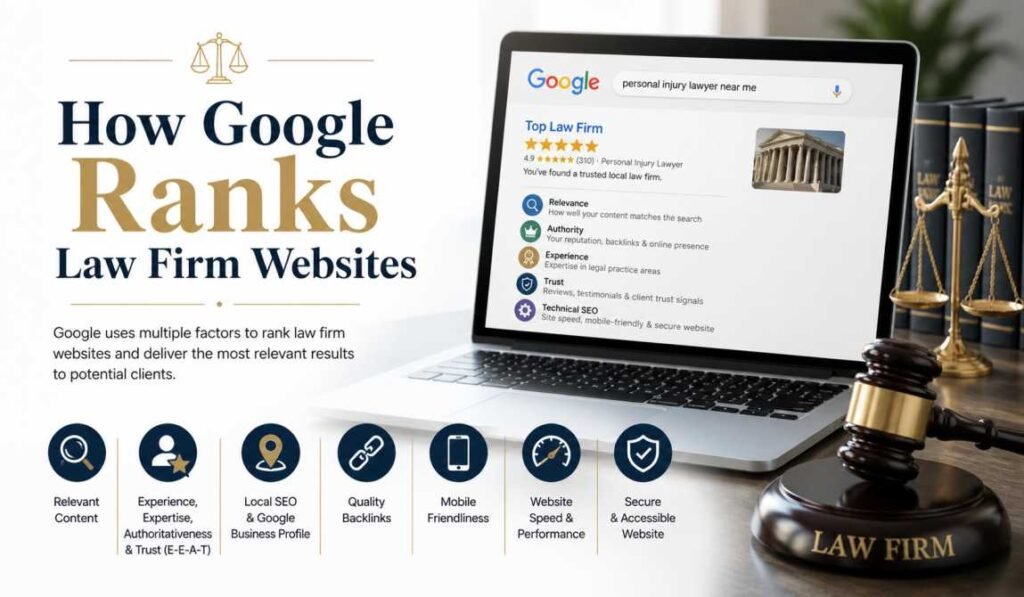
Search engines like Google use complex algorithms to determine which law firm websites should appear in search results. Their goal is to provide users with the most relevant, trustworthy, and helpful information for their search query.
For law firms, ranking well in search results depends on several important SEO factors.
Relevance and Search Intent
Google checks if your page matches what someone searched for. Your website should match the words people use and what they want to find out when looking for legal info.
For example, someone searching for:
- “divorce lawyer in Chicago”
- “personal injury attorney near me”
- “estate planning lawyer”
expects highly relevant local legal results. Law firms that create optimized practice area pages and location-specific content are more likely to rank for these searches.
Understanding search intent is critical because Google prioritizes pages that best answer the user’s needs.
Content Quality and EEAT
In the legal industry, content quality is extremely important. Law is part of Google’s ‘Your Money or Your Life’ (YMYL) category. Google expects legal websites to show strong:
- Experience
- Expertise
- Authoritativeness
- Trustworthiness (EEAT)
High-quality legal content should:
- Answer user questions clearly.
- provide accurate information
- demonstrate legal expertise
- offer practical insights
- maintain professional credibility
Short or unhelpful content is less likely to show up high in search results.
Backlinks and Domain Authority
Getting links from respected websites is one of the best ways to improve law firm SEO. When good sites link to you, search engines trust you more.
High-quality backlinks can help improve:
- domain authority
- search visibility
- keyword rankings
- organic traffic
Because law is very competitive, top law firms often write guest posts, use digital PR, or seek links from respected sites to look better online.
User Experience and Core Web Vitals
Google also cares about how people use your website. If your site is slow or hard to use, rankings can drop even if your content is good.
Important user experience factors include:
- fast page speed
- mobile responsiveness
- easy navigation
- secure browsing (HTTPS)
- clear website structure
Google also looks at factors like how quickly pages load and whether your site stays stable as it loads.
Local SEO Signals
For most law firms, being found locally is very important. Google shows local businesses first for searches about legal help near someone.
Key local SEO signals include:
- optimized Google Business Profile
- consistent business information
- local citations
- online reviews
- location-specific pages
Keyword Research for Law Firm SEO
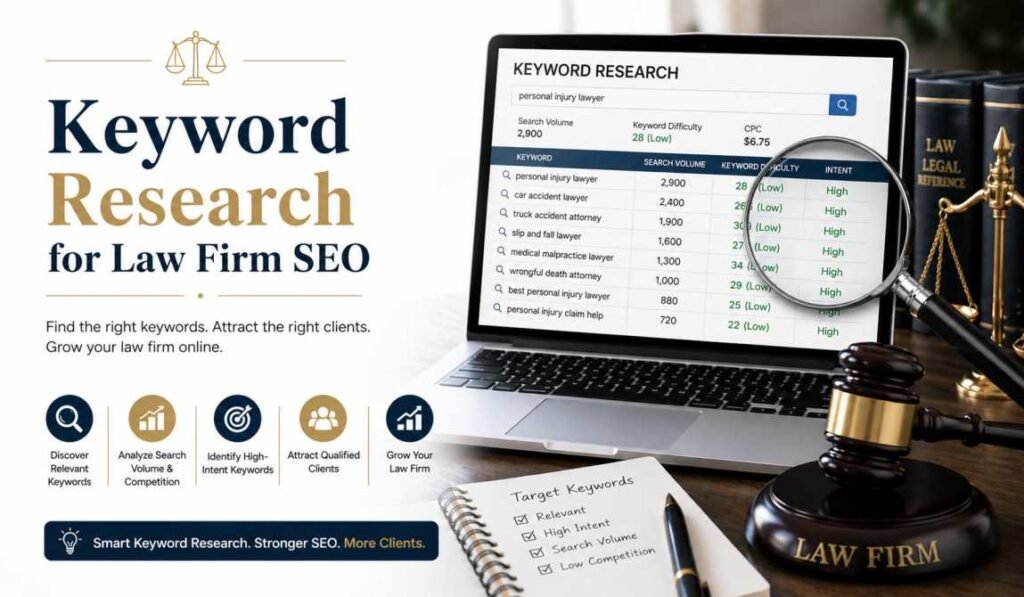
Picking the right words is the first step in law firm SEO. It helps lawyers learn what people search for online and which words will help more clients find them.
Choosing the right keywords enables law firms to target users actively seeking legal services in specific practice areas and locations.
Understanding Search Intent
Before picking search words, it’s important to know what people mean when they search. This is called search intent.
In legal SEO, users may search for:
- informational content
- legal advice
- local attorneys
- consultation services
For example:
- “What does a personal injury lawyer do?” has informational intent
- “personal injury lawyer in New York” has transactional intent.
Law firms should make content that matches what people are really looking for. This helps you show up higher and turn more visitors into clients.
Finding High-Value Legal Keywords
High-value legal keywords are search terms that have strong traffic potential and commercial intent. These keywords often relate directly to legal services and practice areas.
Examples include:
- personal injury lawyer
- divorce attorney
- criminal defense lawyer
- immigration attorney
- estate planning lawyer
Law firms should focus on keywords that are relevant to their services, location, and target audience.
Local Keywords for Lawyers
Local SEO plays a major role in legal marketing because most clients search for attorneys within their area. Adding geographic modifiers to keywords helps law firms target local searches more effectively.
Examples:
- personal injury lawyer in Dallas
- Chicago divorce attorney
- family lawyer near me
Location-specific keywords can improve visibility in local search results and increase qualified leads.
Long-Tail Keywords for Law Firms
Long-tail keywords are more specific search phrases that usually have lower competition and higher conversion potential.
Examples:
- best personal injury lawyer for car accidents
- affordable divorce attorney in Los Angeles
- How to hire a criminal defense lawyer
These keywords often attract users who are closer to making a decision, making them valuable for law firm SEO.
Tools for Legal Keyword Research
Law firms can use SEO tools to discover keyword opportunities, analyze competitors, and estimate search volume. Popular keyword research tools include:
- Google Keyword Planner
- Ahrefs
- SEMrush
- Moz
These tools help identify:
- keyword difficulty
- search trends
- related keywords
- competitor rankings
- local SEO opportunities
Local SEO for Law Firms
Local SEO is one of the most important parts of SEO for law firms because most clients search for legal services within their city or region. Whether someone needs a personal injury attorney, divorce lawyer, or criminal defense attorney, they usually look for nearby legal professionals they can contact quickly.
Strong local SEO helps law firms appear in location-based search results, Google Maps, and the local map pack, thereby significantly increasing calls, website visits, and consultation requests.
Optimizing Your Google Business Profile
A properly optimized Google Business Profile is essential for local law firm SEO. This profile helps your firm appear in Google Maps and local search results when users search for legal services nearby.
Important optimization steps include:
- using the correct business name
- selecting accurate business categories
- Adding contact information
- uploading professional photos
- including business hours
- writing an optimized business description
Keeping your profile updated improves local visibility and trust.
Importance of NAP Consistency
NAP stands for:
- Name
- Address
- Phone Number
Your law firm’s NAP information should remain consistent across:
- your website
- legal directories
- social media profiles
- local citations
- business listings
Inconsistent business information can confuse search engines and negatively affect local rankings.
Local Citations and Legal Directories
Local citations are online mentions of your law firm’s contact information. These citations help search engines verify the legitimacy and location of your business.
Law firms should create profiles on reputable legal and local directories such as:
- Avvo
- Justia
- FindLaw
- Yelp
Strong citation profiles can improve local authority and search visibility.
Getting Client Reviews
Online reviews are a major trust and ranking factor for legal SEO. Positive reviews help law firms build credibility while improving local search performance.
Encourage satisfied clients to leave reviews on:
- legal directories
- local business platforms
Responding professionally to reviews also helps strengthen your online reputation.
Local Landing Pages and Map Pack Rankings
Law firms serving multiple locations should create dedicated landing pages for each city or service area. These pages should include:
- location-specific keywords
- unique content
- practice area details
- local information
- client-focused content
Well-optimized local pages improve the chances of appearing in Google’s local map pack, which is one of the most valuable placements in local search results.
A strong local SEO strategy helps law firms attract nearby clients, improve online visibility, and compete more effectively in local legal markets.
On-Page SEO for Lawyers
On-page SEO refers to the process of optimizing individual pages on a law firm’s website to improve search rankings and user experience. Proper on-page optimization helps search engines understand your content while making it easier for potential clients to navigate your website.
For law firms, strong on-page SEO can improve visibility for practice area pages, blog content, and local landing pages.
SEO-Friendly Titles and Meta Descriptions
Title tags and meta descriptions are important on-page SEO elements because they influence both rankings and click-through rates.
A strong SEO title should:
- include the target keyword
- clearly describe the page
- remain concise and readable
Meta descriptions should summarize the page content while encouraging users to click from search results.
For example, a personal injury law page should clearly mention:
- the legal service
- target location
- value offered to clients
Optimizing Headings and Content Structure
Well-structured content improves readability and helps search engines understand a page’s topic.
Law firm websites should use:
- One H1 heading per page
- organized H2 and H3 subheadings
- short paragraphs
- bullet points where appropriate
A clear structure makes legal content easier for users to scan and improves overall engagement.
Internal Linking Strategy
Internal links help connect related pages across a law firm’s website. This improves navigation while helping search engines understand the relationship between different topics and practice areas.
Examples of internal linking:
- linking blog posts to service pages
- connecting related legal topics
- linking location pages together
Strong internal linking also helps distribute authority throughout the website.
Image Optimization and Alt Text
Images can improve user experience, but they should also be optimized for SEO.
Best practices include:
- compressing image sizes for faster loading
- using descriptive filenames
- Adding relevant alt text
- avoiding oversized media files
Alt text helps search engines understand image content and improves accessibility.
SEO-Friendly URL Structure
URLs should remain short, descriptive, and keyword-focused. Clean URLs improve both usability and search engine understanding.
Good example:
- /personal-injury-lawyer-chicago
Poor example:
- /page?id=1457
A properly optimized URL structure helps improve crawlability and makes pages easier to understand for users and search engines alike.
Strong on-page SEO creates a better user experience while improving a law firm’s ability to rank for competitive legal keywords.
Content Marketing for Law Firms
Content marketing plays a major role in SEO for law firms because high-quality content helps attract organic traffic, answer client questions, and improve search visibility. Well-optimized legal content also helps law firms build authority and trust in competitive search results.
A strong content strategy allows attorneys to target valuable keywords while educating potential clients throughout their decision-making process.
Creating Practice Area Pages
Practice area pages are among the most important on a law firm website. These pages should clearly explain the legal services your firm provides while targeting relevant keywords.
Examples include:
- personal injury law
- family law
- criminal defense
- immigration law
- estate planning
Each practice area page should contain:
- detailed service information
- location relevance
- client-focused language
- clear calls to action
- optimized headings and keywords
Well-structured service pages can significantly improve rankings and lead generation.
Writing Educational Legal Blogs
Legal blog content helps law firms target informational keywords and answer common client questions. Educational content can also improve topical authority and increase long-term organic traffic.
Examples of effective legal blog topics:
- What to do after a car accident
- How child custody works
- steps in filing for divorce
- Understanding Criminal Charges
Publishing helpful and accurate legal content builds trust with both users and search engines.
Building Topical Authority
Topical authority refers to how comprehensively a website covers a subject area. Law firms that consistently publish high-quality legal content are more likely to be viewed as authoritative sources.
To build topical authority, law firms should create:
- practice area clusters
- FAQ content
- legal guides
- local service pages
- educational resources
A strong content ecosystem helps improve rankings across multiple related keywords.
Using FAQs to Capture More Traffic
FAQ sections can help law firms target long-tail searches and featured snippets in search results. Many users search legal questions directly on Google before contacting an attorney.
Examples:
- How long does a personal injury case take?
- What should I do after an arrest?
- How much does a divorce lawyer cost?
Answering these questions clearly can improve visibility and increase organic traffic.
Content Optimization Best Practices
Legal content should be written for both users and search engines. Important content optimization practices include:
- using relevant keywords naturally
- improving readability
- adding internal links
- updating outdated information
- optimizing headings and structure
Because the legal niche falls under Google’s YMYL guidelines, content accuracy and trustworthiness are especially important.
Consistent content marketing helps law firms strengthen online authority, improve search rankings, and attract more qualified legal leads over time.
The Importance of Backlinks in Legal SEO
Backlinks are one of the most important ranking factors in SEO for law firms. A backlink is a link from another website pointing to your law firm’s website. Search engines view these links as signals of trust and authority, especially when they come from reputable and relevant websites.
In highly competitive legal markets, strong backlinks can significantly improve search visibility and help law firms rank higher for valuable keywords.
What Are Backlinks?
Backlinks act as recommendations from other websites. When authoritative websites link to your content, search engines interpret those links as a sign that your website provides valuable and trustworthy information.
However, not all backlinks are equal. A few high-quality backlinks from reputable legal or business websites are usually more valuable than hundreds of low-quality links.
Why Backlinks Matter for Law Firm Rankings
The legal industry is extremely competitive online, and many top-ranking law firm websites have strong backlink profiles. Backlinks help improve:
- domain authority
- search rankings
- organic traffic
- brand credibility
- trust signals
For competitive legal keywords, backlinks often play a major role in determining which websites rank on the first page of search results.
Authority Links and Trust Signals
Search engines prioritize websites that demonstrate authority and trustworthiness. Backlinks from respected sources can strengthen a law firm’s online reputation and improve EEAT signals.
Valuable backlink sources may include:
- legal publications
- business websites
- local news sites
- niche blogs
- industry directories
Earning links from authoritative websites can improve both rankings and brand visibility.
What Makes a High-Quality Legal Backlink?
Not all backlinks provide the same SEO value. For law firms, links from authoritative and relevant websites are far more beneficial than a large number of low-quality links. Search engines consider factors such as the linking website’s authority, topical relevance, editorial standards, and placement of the link. A backlink from a respected legal publication, bar association, or trusted industry website generally carries more weight than links from unrelated or low-quality directories. Focusing on quality over quantity helps law firms build long-term authority and maintain sustainable search rankings.
Guest Posting for Lawyers
Guest posting is one of the most effective white-hat link-building strategies for law firms. It involves publishing high-quality content on relevant websites in exchange for an editorial backlink.
Benefits of legal guest posting include:
- improved domain authority
- targeted referral traffic
- stronger brand recognition
- better keyword rankings
- increased online credibility
When done correctly, guest posting helps law firmLaw firms should focus on ethical,d sustainable link-building methods rather than spammy backlink tactics. focus on ethica,d sustainable link-building methodsrather thanf spammy backlink tactic.s.
Effective white-hat strategies include:
- guest posting
- digital PR
- legal resource pages
- local citations
- creating valuable legal content
- industry partnerships
Avoiding low-quality or manipulative backlink schemes is important because spammy links can harm rankings and damage website trust.
A strong backlink strategy helps law firms build authority, compete for difficult legal keywords, and improve long-term organic search performance.
Technical SEO for Law Firms
Technical SEO focuses on improving the structure and performance of a law firm’s website so search engines can crawl, index, and rank pages more effectively. Even high-quality legal content may struggle to rank if a website has technical SEO issues.
A technically optimized website also improves user experience, which is an important ranking factor in modern SEO.
Mobile Optimization
Most users searching for legal services now browse on mobile devices. Law firm websites must provide a smooth mobile experience across all screen sizes.
A mobile-friendly website should have:
- responsive design
- readable text
- fast-loading pages
- easy navigation
- click-friendly buttons
Because Google uses mobile-first indexing, poor mobile usability can negatively impact search rankings.
Improving Website Speed
Website speed directly affects both user experience and SEO performance. Slow-loading pages can increase bounce rates and reduce conversions.
Law firms can improve site speed by:
- compressing images
- Reducing unnecessary scripts
- using fast hosting
- enabling browser caching
- optimizing website code
Faster websites generally perform better in search results and provide a better experience for potential clients.
Core Web Vitals Explained
Core Web Vitals are performance metrics that measure user experience on a website. Google uses these signals as part of its ranking systems.
Important Core Web Vitals include:
- loading speed
- visual stability
- page responsiveness
Websites that offer a smooth, stable experience are more likely to perform well in organic search.
HTTPS and Website Security
Security is especially important for law firm websites, as users may submit sensitive personal information via contact forms.
HTTPS encryption helps:
- secure user data
- improve trust
- Protect website integrity
Google also considers HTTPS a ranking signal, making website security essential for legal SEO.
Schema Markup for Legal Websites
Schema markup is structured data added to a website to help search engines better understand content.
Law firms can use schema to provide information such as:
- business details
- reviews
- legal services
- FAQs
- contact information
Structured data can improve search visibility and increase the chances of earning rich results in search listings.
Strong technical SEO helps law firms improve website performance, enhance user experience, and support long-term search engine rankings.
Common Law Firm SEO Mistakes to Avoid
Many law firms invest in SEO but fail to achieve strong results due to avoidable mistakes. In a competitive legal market, even small SEO issues can impact rankings, traffic, and lead generation.
Understanding these common mistakes can help law firms build a stronger and more sustainable SEO strategy.
Keyword Stuffing
One of the most common SEO mistakes is overusing keywords throughout website content. Some law firms try to rank higher by repeatedly adding the same keyword unnaturally across pages.
For example, excessively repeating phrases like:
- “best personal injury lawyer”
- “top divorce attorney”
- “law firm SEO”
can make content look spammy and reduce readability.
Modern SEO focuses on natural language, search intent, and semantic relevance rather than keyword repetition.
Thin or Duplicate Content
Thin content provides little value to users and often lacks depth, originality, or useful information. Duplicate content occurs when similar text appears across multiple pages.
This issue is common on law firm websites that create nearly identical content. Answer user questions clearly without unique content.
High-quality legal content should:
- Answer user questions clearly.
- provide useful information
- demonstrate expertise
- offer original insights
Unique and detailed content performs much better in competitive legal search results.
Ignoring Local SEO
Many law firms underestimate the importance of local SEO. Since most legal searches are location-based, weak local optimization can significantly limit visibility.
Common local SEO mistakes include:
- incomplete Google Business Profile
- inconsistent business information
- lack of local landing pages
- missing reviews
- weak local citations
Strong local SEO is essential for attracting nearby clients and improving map pack rankings.
Poor Mobile Experience
A website that performs poorly on mobile devices can hurt both user experience and rankings. Many users searching for attorneys browse on smartphones, especially during urgent legal situations.
Common mobile SEO problems include:
- slow-loading pages
- difficult navigation
- small text
- intrusive popups
- unresponsive layouts
Improving mobile usability helps law firms retain visitors and increase conversions.
Spammy Link Building
Low-quality backlinks can damage a website’s authority and trustworthiness. Some law firms use spammy link-building tactics such as:
- buying bulk backlinks
- using private blog networks
- automated link schemes
- irrelevant directory links
Search engines prioritize natural, authoritative backlinks over manipulative tactics.
Focusing on ethical strategies like guest posting, digital PR, and high-quality content is a much safer and more effective long-term approach.
Avoiding these SEO mistakes can help law firms improve search performance, build stronger online authority, and generate more qualified legal leads over time.
Best SEO Strategies for Small Law Firms
Small law firms often compete with larger firms that have bigger marketing budgets, but effective SEO can still help smaller practices achieve strong online visibility and attract qualified clients. By focusing on the right strategies, small law firms can compete successfully in local search results and build long-term authority.
Targeting Specific Practice Areas
Instead of trying to rank for broad legal keywords, small law firms should focus on specific practice areas and niche services.
Examples include:
- motorcycle accident lawyer
- child custody attorney
- immigration visa lawyer
- DUI defense attorney
Targeting niche keywords usually reduces competition and improves the chances of ranking for highly relevant searches.
Focusing on Local SEO
Local SEO is one of the most effective growth strategies for small law firms. Many legal searches have strong local intent, which means users are looking for attorneys nearby.
Small firms should prioritize:
- optimizing Google Business Profile
- collecting client reviews
- building local citations
- creating city-specific landing pages
- targeting location-based keywords
Strong local SEO can help smaller firms compete against larger competitors in specific geographic areas.
Publishing Consistent Content
Consistent content publishing helps law firms build topical authority and improve organic visibility over time.
Small law firms can create content such as:
- legal guides
- FAQs
- blog posts
- local legal resources
- case-related educational content
Regularly updated content signals activity and expertise to search engines while helping attract long-tail keyword traffic.
Building High-Quality Backlinks
Backlinks remain essential for legal SEO, especially in competitive markets. Small law firms should focus on earning high-quality links rather than large quantities of low-value backlinks.
Effective strategies include:
- guest posting
- local partnerships
- legal directories
- digital PR
- creating link-worthy legal content
Authoritative backlinks can help smaller law firms strengthen domain authority and improve rankings for competitive legal searches.
Managing Online Reputation
Online reputation plays an important role in both SEO and client trust. Positive reviews and strong brand credibility can influence search rankings and conversion rates.
Law firms should actively manage:
- Google reviews
- legal directory profiles
- client feedback
- social proof
- local brand visibility
A strong reputation can help small law firms stand out and build trust with potential clients searching online.
With the right SEO strategy, small law firms can improve visibility, attract targeted leads, and compete effectively in local legal markets without relying entirely on paid advertising.
How Long Does Law Firm SEO Take?
Law firm SEO is a long-term strategy, and results usually do not happen overnight. Because the legal industry is highly competitive, it often takes time to build authority, improve rankings, and generate consistent organic traffic.
While some improvements may appear within a few weeks, meaningful SEO growth typically requires ongoing optimization and consistent effort.
Factors That Affect SEO Results
Several factors influence how quickly a law firm can see SEO results, including:
- website age and authority
- competition level
- backlink profile
- content quality
- local SEO strength
- technical website performance
For example, ranking in a smaller local market is generally easier than competing for highly competitive keywords in major cities.
Realistic SEO Timelines for Lawyers
Although every law firm is different, general SEO timelines often look like this:
- 1–3 months: technical fixes, indexing improvements, local SEO optimization
- 3–6 months: gradual keyword ranking improvements and traffic growth
- 6–12 months: stronger authority, competitive keyword rankings, increased lead generation
Highly competitive legal keywords may take longer, especially for newer websites with limited authority.
Importance of Consistency and Authority
SEO success for law firms depends heavily on consistency. Publishing quality content, improving local SEO, and earning authoritative backlinks over time help strengthen long-term search visibility.
Law firms that consistently invest in:
- content marketing
- technical SEO
- local optimization
- Authority link building
They are more likely to achieve sustainable rankings and long-term organic growth.
Unlike paid advertising, SEO compounds over time. A well-optimized legal website can continue generating traffic and leads long after the initial optimization work is completed.
How to Measure SEO Success for Law Firms
Measuring SEO performance is essential to understand whether your strategy is generating real business results. While higher search rankings are important, the ultimate goal of law firm SEO is to attract qualified clients, increase consultation requests, and grow your practice. By tracking the right metrics, law firms can identify what’s working, uncover areas for improvement, and make informed decisions to maximize their return on investment.
Organic Traffic
Organic traffic measures the number of visitors who find your website through unpaid search results. A steady increase in organic traffic indicates that your SEO efforts are improving your website’s visibility. Google Analytics can help you monitor traffic trends, identify your top-performing pages, and understand how users interact with your content.
Keyword Rankings
Tracking keyword rankings helps you see how well your website performs for important search terms such as “personal injury lawyer,” “family law attorney,” or “SEO for law firms.” While rankings may fluctuate, consistent improvement for relevant keywords is a strong sign that your SEO strategy is moving in the right direction.
Google Business Profile Performance
For law firms targeting local clients, Google Business Profile insights are an important performance indicator. Monitor metrics such as profile views, phone calls, direction requests, and website clicks to understand how potential clients are finding and engaging with your firm through local search results.
Leads and Consultation Requests
SEO success should ultimately be measured by the number of qualified leads it generates. Track contact form submissions, phone calls, consultation bookings, and email inquiries that originate from organic search. These metrics provide a clearer picture of how SEO contributes to new client acquisition and business growth.
Conversion Rate
Generating traffic is only part of the process. Your website should also encourage visitors to take action. Measuring your conversion rate—the percentage of visitors who become leads—helps determine whether your landing pages, calls to action, and overall user experience are effectively turning website visitors into potential clients.
Continuous Monitoring and Improvement
SEO is an ongoing process, not a one-time task. Regularly reviewing performance data through tools like Google Search Console and Google Analytics helps law firms identify new keyword opportunities, improve underperforming pages, and adapt to changes in search engine algorithms. Consistent monitoring and optimization are key to maintaining strong search visibility and achieving long-term organic growth.
How Much Does SEO for Law Firms Cost?
The cost of SEO for law firms varies depending on several factors, including the firm’s size, practice areas, target locations, competition, and business goals. Unlike paid advertising, SEO is a long-term investment designed to improve organic visibility, attract qualified leads, and generate consistent client inquiries over time. While there is no fixed price, understanding the common pricing models can help law firms choose the right SEO strategy for their budget and objectives.
Monthly SEO Services
Most law firms invest in ongoing monthly SEO because search engine optimization requires continuous effort. A monthly SEO campaign typically includes keyword research, content creation, on-page optimization, technical SEO, local SEO, backlink building, performance monitoring, and regular reporting. For firms operating in competitive legal markets, ongoing optimization is essential to maintain and improve search rankings over time.
One-Time SEO Audit
Some law firms begin with a one-time SEO audit before committing to a long-term strategy. An SEO audit identifies technical issues, content gaps, keyword opportunities, broken links, indexing problems, and other factors that may be limiting search performance. It provides a clear roadmap for improving the website and is often the first step for firms with an existing online presence.
Local SEO Pricing
Law firms that primarily serve clients within a specific city or region often focus on local SEO. This typically includes optimizing the Google Business Profile, improving local citations, managing online reviews, creating location-specific pages, and targeting geo-specific keywords. Local SEO is generally more cost-effective than nationwide campaigns while delivering highly qualified local leads.
Enterprise SEO for Large Law Firms
Large law firms with multiple offices or a national presence usually require a more comprehensive SEO strategy. Enterprise SEO often involves managing hundreds of web pages, optimizing multiple practice areas and locations, implementing advanced technical SEO, publishing large volumes of content, and earning authoritative backlinks. These campaigns require greater resources and ongoing collaboration to compete in highly competitive legal markets.
Why SEO Pricing Varies
SEO costs can differ significantly because every law firm has unique goals and challenges. Factors such as website size, competition, geographic targeting, content requirements, and backlink acquisition all influence the level of work required. Rather than choosing the lowest-priced service, law firms should look for an SEO strategy that focuses on sustainable growth, ethical optimization, and measurable business results. A well-executed SEO campaign can deliver long-term value by increasing search visibility, generating qualified leads, and reducing reliance on paid advertising.
Law Firm SEO Checklist for Beginners
If you are just starting with SEO for law firms, following a structured checklist can help ensure your website is properly optimized for search engines and potential clients.
Use this beginner-friendly SEO checklist to improve your law firm’s online visibility and build a stronger foundation for long-term rankings.
Basic Law Firm SEO Checklist
- Create a mobile-friendly website.
- Secure your website with HTTPS.
- Improve website loading speed.
- Set up Google Search Console
- Install Google Analytics
- Optimize website navigation and structure.
Keyword Optimization Checklist
- Research relevant legal keywords
- Target location-based keywords
- Use keywords naturally in headings and content.
- Optimize title tags and meta descriptions.
- Create SEO-friendly URLs
- Add internal links between related pages.
Local SEO Checklist
- Optimize your Google Business Profile
- Maintain consistent NAP information.
- Build local citations
- Collect client reviews
- Create local landing pages.
- Target “near me” and city-specific searches
Content Marketing Checklist
- Create detailed practice area pages.
- Publish educational legal blog content.
- Add FAQ sections to important pages.
- Update outdated content regularly.
- Improve readability and content structure.
- Focus on user intent and helpful information.
Technical SEO Checklist
- Fix broken links
- Compress large images
- Improve Core Web Vitals
- Submit XML sitemap
- Ensure pages are indexed properly.
- Add schema markup where relevant.
Link Building Checklist
- Earn backlinks from authoritative websites.
- Use guest posting for legal SEO
- Build local business partnerships.
- Avoid spammy backlink tactics.
- Strengthen domain authority gradually.
Best SEO Tools for Lawyers and Law Firms
Using the right SEO tools can help law firms improve keyword research, monitor rankings, analyze competitors, and identify technical SEO issues. These tools provide valuable data that can support better decision-making and improve overall SEO performance.
Keyword Research Tools
Keyword research tools help law firms discover search terms that potential clients are using online. They also provide insights into search volume, competition, and keyword trends.
Popular keyword research tools include:
- Google Keyword Planner
- Ahrefs
- SEMrush
- Moz
These platforms can help identify:
- legal SEO keywords
- local keyword opportunities
- competitor rankings
- long-tail search terms
Technical SEO Tools
Technical SEO tools help identify website issues that may affect search visibility and user experience.
Useful technical SEO tools include:
- Google Search Console
- Screaming Frog
- GTmetrix
- PageSpeed Insights
These tools help monitor:
- crawl errors
- indexing issues
- page speed
- broken links
- Core Web Vitals
Analytics and Tracking Tools
Tracking SEO performance is essential for measuring growth and identifying opportunities for improvement.
Law firms can use:
- Google Analytics
- Looker Studio
- rank tracking tools
- call tracking software
These tools help monitor:
- organic traffic
- user behavior
- conversions
- consultation requests
- keyword rankings
Competitor Research Tools
Competitor analysis tools enable law firms to examine competing websites and identify successful SEO strategies in the legal industry.
Platforms like Ahrefs and SEMrush can help analyze:
- backlink profiles
- top-performing content
- keyword rankings
- traffic estimates
- authority metrics
Understanding competitor strategies can help law firms discover new opportunities and improve their own SEO campaigns.
Using the right combination of SEO tools can simplify optimization efforts, improve decision-making, and help law firms achieve stronger long-term search visibility.
Future Trends in SEO for Law Firms
SEO continues to evolve as search engines become more advanced and user behavior changes. Law firms that stay up to date with emerging SEO trends are more likely to maintain strong search visibility and remain competitive in the legal industry.
Understanding future SEO trends can help law firms adapt their digital marketing strategies for long-term growth.
AI and Search Engines
Artificial intelligence is changing how search engines understand and rank content. Modern algorithms can better evaluate:
- search intent
- content quality
- user behavior
- semantic relevance
Law firms should focus on creating helpful, experience-driven content rather than relying on outdated keyword-stuffing tactics. High-quality legal content that demonstrates expertise and trustworthiness is becoming increasingly important.
EEAT and Trust Signals
Because legal websites fall under Google’s YMYL guidelines, EEAT signals will continue to play a major role in rankings.
Law firms should strengthen:
- author credibility
- legal expertise
- client trust
- authoritative backlinks
- online reputation
Websites that demonstrate strong trust signals are more likely to perform well in competitive legal search results.
Voice Search and User Experience
Voice search usage continues to grow, especially for local searches. Many users now search using conversational phrases such as:
- “best divorce lawyer near me”
- “personal injury attorney in Chicago”
- “How to hire a criminal defense lawyer.”
Optimizing for natural language queries and improving website usability can help law firms capture more voice and mobile search traffic.
Entity SEO and Semantic Search
Search engines are increasingly focused on understanding topics, entities, and relationships between concepts rather than relying only on exact-match keywords.
This means law firms should build strong topical authority through:
- comprehensive legal content
- semantic keyword coverage
- practice area clusters
- FAQ optimization
- internal linking
Modern SEO is increasingly focused on overall topic relevance and user satisfaction rather than simple keyword repetition.
Law firms that prioritize quality content, strong authority signals, and excellent user experience will be better positioned for long-term SEO success as search algorithms continue to evolve.
Should Law Firms Hire an SEO Agency?
Many law firms eventually face the decision of whether to manage SEO in-house or hire an SEO agency. While some basic optimization tasks can be handled in-house, legal SEO is highly competitive and often requires specialized expertise, consistent effort, and long-term strategy.
Choosing the right approach depends on the law firm’s goals, resources, and the level of competition.
DIY SEO vs Professional SEO
Small law firms with limited budgets may start with basic SEO tasks such as:
- optimizing service pages
- creating blog content
- improving local SEO
- managing Google Business Profile
However, competitive legal SEO often involves advanced strategies such as:
- technical optimization
- competitor analysis
- Authority link building
- content strategy
- performance tracking
Professional SEO agencies typically have the tools and experience needed to manage these areas more effectively.
Benefits of Hiring Legal SEO Experts
An experienced legal SEO agency understands the unique challenges of the legal industry and can help law firms improve visibility in competitive search results.
Benefits of hiring SEO professionals may include:
- faster identification of SEO opportunities
- improved technical optimization
- strategic keyword targeting
- higher-quality content planning
- stronger backlink acquisition
- Ongoing performance monitoring
Professional guidance can also help law firms avoid common SEO mistakes that may negatively impact rankings.
Importance of Authority Link Building
One of the most difficult parts of legal SEO is building authoritative backlinks. Because legal keywords are highly competitive, strong backlink profiles often play a major role in ranking success.
Professional SEO agencies may help law firms acquire:
- editorial backlinks
- legal guest posts
- niche-relevant authority links
- digital PR placements
High-quality backlinks can strengthen domain authority, improve search rankings, and increase organic traffic over time.
For many law firms, partnering with an experienced SEO provider can save time, improve long-term results, and create a more sustainable online marketing strategy.
Final Thoughts on SEO for Law Firms
SEO for law firms is no longer optional in today’s competitive digital landscape. Potential clients increasingly rely on search engines to find legal services, compare attorneys, and choose law firms they can trust. Without a strong online presence, even experienced law firms may struggle to compete effectively in local search results.
A successful legal SEO strategy involves more than simply targeting keywords. Law firms need to focus on:
- high-quality content
- local SEO
- technical optimization
- user experience
- authoritative backlinks
- long-term trust building
Because the legal industry is highly competitive, consistent effort and strategic optimization are essential for achieving sustainable rankings and generating qualified leads through organic search.
Whether you run a small local practice or a growing legal firm, investing in SEO can help improve visibility, strengthen credibility, and attract more potential clients over time. By combining helpful legal content with strong authority-building strategies such as ethical link building and guest posting, law firms can build long-term online growth and compete more effectively in search results.
Frequently Asked Questions (FAQs)
SEO for law firms is the process of optimizing a law firm’s website to improve its visibility in search engine results. It involves keyword research, local SEO, content marketing, technical SEO, and link building to attract potential clients searching for legal services online.
SEO helps lawyers reach potential clients who are actively searching for legal services on Google. Higher search rankings increase website visibility, generate qualified leads, build credibility, and reduce reliance on paid advertising over the long term.
Most law firms begin seeing noticeable SEO improvements within 3 to 6 months, while competitive legal keywords may take 6 to 12 months or longer. Results depend on factors such as competition, website authority, content quality, and backlink profile.
The cost of SEO for law firms varies depending on the size of the firm, target locations, competition, and campaign scope. Ongoing SEO services, local SEO, and one-time SEO audits all have different pricing models. Investing in a long-term SEO strategy can provide consistent organic traffic and qualified leads.
Some of the most effective SEO strategies for lawyers include optimizing practice area pages, improving local SEO, publishing high-quality legal content, earning authoritative backlinks, maintaining a Google Business Profile, and regularly monitoring website performance.
Yes. Local SEO is essential because most clients search for lawyers in their city or nearby area. Optimizing your Google Business Profile, maintaining consistent business information, collecting client reviews, and creating location-specific pages can improve local search rankings and attract more qualified clients.
SEO focuses on improving organic search rankings and delivers long-term results without paying for every click. Google Ads provides immediate visibility through paid advertisements but stops generating traffic when the advertising budget ends. Many law firms use both strategies together for the best results.
Yes. High-quality backlinks from reputable legal websites, industry publications, and trusted business directories help improve a law firm’s authority and search rankings. Ethical link-building strategies such as guest posting and digital PR are more effective than low-quality or spammy backlinks.
Yes. Small law firms can compete by targeting niche practice areas, focusing on local SEO, creating helpful legal content, and building high-quality backlinks. A well-planned SEO strategy can help smaller firms rank for location-specific and long-tail keywords, even in competitive markets.
Hiring an experienced SEO agency can help law firms improve technical SEO, develop an effective content strategy, build authoritative backlinks, and monitor performance. While some SEO tasks can be managed in-house, professional expertise is often beneficial in highly competitive legal markets.
There is very little difference between SEO for lawyers and SEO for law firms. Both focus on improving online visibility in search engines through keyword optimization, local SEO, content marketing, technical SEO, and link building. The main distinction is that SEO for lawyers may target individual attorneys, while SEO for law firms typically focuses on promoting the entire legal practice, including multiple practice areas and office locations.